By
Super User
Best Travel To Mundari Tribe/People Cattle Camp Of South Sudan
Best Travel To Mundari Tribe/People Cattle Camp Of South Sudan
Indigenous to the Nile Valley in South Sudan, the Mundari is a small ethnic group of roughly 100,000 (very tall) people. As is the case for many other tribes in the area, everything is about the cows for the Mundari. Cattle are the Mundari’s primary source of wealth; the cows serve as a form of currency, and, as such, have become a symbol of status and power. And the cows are magnificent. These Ankole-Watusi cows are gigantic and have impressive curly horns. They are also remarkably friendly, even with an uninformed foreigner who repeatedly walks in their paths and disturbs their activities.
About the Mundari People:
The Mundari are one of the ethnic groups indigenous to the Nile Valley (Nilotic). Their main homeland is approximately 75 kilometers north of Juba, the capital of South Sudan. Their lands are bounded on the east by the White Nile, an important source of water for livestock. The traditional Mundari tribal lands are centered in the town of Terekeka in the state of Central Equatoria. The Bor Dinka at, Pariak, borders them to the south, to the north by the Bari.
The Mundari, like other Nilotic tribes, are very cattle-oriented: cattle serve as a form of currency and a mark of status. The prospective groom offering cattle to the bride’s family arranges marriages and husbands may take as many wives as they can support.
Mundari Language:
Mundari (Munɖari) is a Munda language of the Austroasiatic language family spoken by the Munda tribes in the eastern Indian states of Jharkhand, Odisha, and West Bengal. It is closely related to Santali.
Diet of the Mundari People:
But incredibly, they never eat their flesh and their diet consists mainly of milk and yogurt. 'The Mundari do not see the difference between man and cow. They eat, sleep, and walk together. The cows are everything to them - currency, food, and pride
The Mundari, like other Nilotic tribes, the Mundari engage in perennial cattle-raiding wars with the Bor Dinka during the dry season. Mundari men are known to bathe their hair in cow urine, giving it a yellow-orange color. The Mundari also cultivate sorghum and catch fish using nets and spears.
In common with other Nilotic tribes in Sudan, the Mundari practice ritual scarification as a rite of passage into adulthood for young men. The typical Mundari scar pattern consists of two sets of three parallel lines, each on either side of the forehead, extending in a downward slope and unconnected in the middle
Culture of the Mundari People:
The Mundari are a semi-nomadic people. Women, children, and the elderly stay in a permanent village while the men and boys accompany the cattle searching for grazing. To do so, they live in a temporary camp, where they can keep a close eye on their “property.” There are a few young women in the camp, helping out with some cattle-related activities, but mostly cooking and taking care of their infants or young children who accompany them.
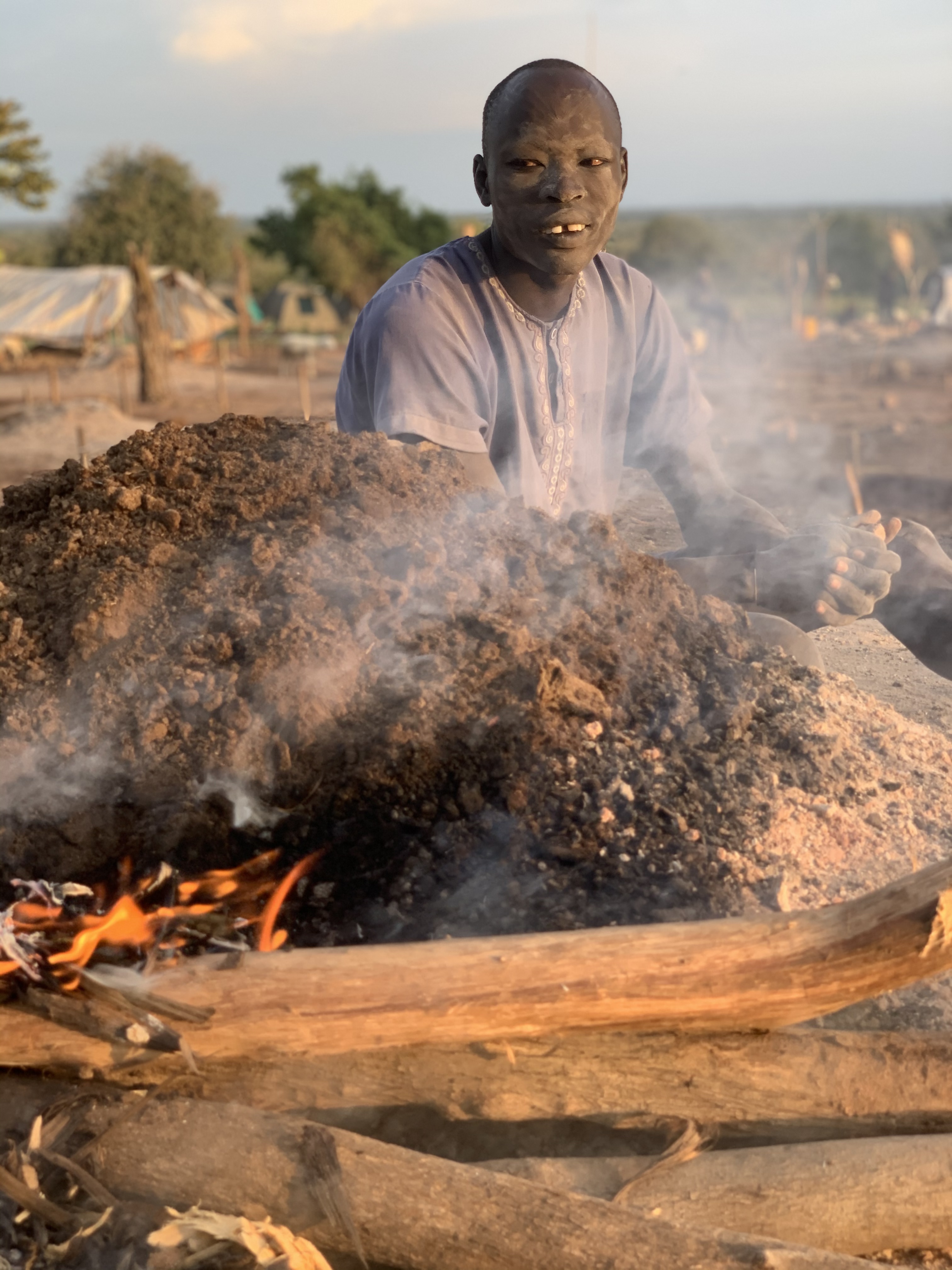
The activities in a cattle camp are quite predictable. At dawn and dusk, fires are lit to burn heaps of dung that have been collected and dried. The ashes from the dung fire are turned into a light orange powder used to lovingly massage the cows, serving as both a fly-repellent and sunscreen. The Mundari also cover their bodies with those ashes, hoping for the same benefits.
After the cows have been massaged in the morning, they are taken to grazing fields, where they stay for the day. At the end of the day, the cows return with their herders and go straight to their assigned “home,” where they are tethered to a piece of wood. Music is often played to welcome them back. After their return, the cows are sometimes massaged again or beautified in other ways, such as trimming their horns. Men and boys sleep among the precious cattle at night, ready to guard them against a potential raid from humans or wild animals.
Traditionally, Mundari’s men have sported a V-shaped scar on their forehead to indicate that they had completed their initiation rites into adulthood. However, Mundari no longer practices this ritual scarification. One practice that is still prominent is for boys and young men to color the top of their hair in a lighter shade, apparently as a way to attract young ladies. To achieve this, they immerse their hair in cow urine, preferably in the morning when it is most potent. Moreover, it is not unusual to see people rushing to catch cow urine to wash their hands, using it as an antiseptic.
Book with Ultimate Wild Safaris for the Mundari People safari tour.
Email: This email address is being protected from spambots. You need JavaScript enabled to view it.
Mobile: +256 705 087 906 / 760 282 342