By
Super User
Best Travel Guide To Didinga People/Tribe In South Sudan
Best Travel Guide To Didinga People/Tribe In South Sudan
No doubt that South Sudan is one of the most challenging destinations for the intrepid traveler. This is the world’s newest nation, founded in 2011, and probably Africa's least visited country. In South Sudan, you will not find traditional “sights”. In fact, for most of the country, you will not find "traditional roads" either. What you will find though is ancient cultural rituals, a myriad of colorful local tribes, and raw natural beauty.
About the Didinga People:
The Didinga people reside in the Didinga hills, including the valleys, plateaus, slopes, and nearby plains. The Boya, Toposa, Dodoth, Dongotono, and Lotuka/Lopit are among their neighbors. Although there have been conflicts in the past, they presently coexist peacefully, intermarry, and speak a language related to that of the Boya, Murle, and Tenet.
The Didinga, Boya, and Murle share a language that distinguishes them from all other groups in South Sudan. A group living in southwest Ethiopia also speaks their language, often called the Murle-Didinga language.
History of the Didinga Tribe:
According to tradition, the Didinga immigrated to their current location during the sixteenth century, either from Lake Turkana or Ethiopia, as part of a larger group. The Didinga was located in the Catholic area when the East and West banks of the Nile were split during the British era into Protestant and Catholic influence areas. A small amount of Catholic influence, but not true faith, still exists among certain older individuals. Didinga people are farmers by need and pastoralists by inclination.
The Didinga claim to have lived in southwest Ethiopia two hundred years ago. During their migration to the Didinga Hills, the Didinga, Murle, Tennet, and Boya were one group. They lived in harmony in Sudan until a hunting party dispute caused the Murle to leave. Later, a famine caused the Boya to withdraw.
At 2000 meters above sea level, the region receives enough rainfall to support two crops per year, making cow herding extremely essential.
What Are Their Lives Like?
For many years, the Didinga enjoyed a quiet, rural life. They took great pride in raising cattle and owned large herds that were supervised by the young single Didinga men. However, in 1963, a political disturbance, which lasted until 1973, caused many Didinga to leave their cattle behind and migrate to Uganda. While in Uganda, for the first time in their lives, Didinga was exposed to large-scale farming. Also, their children were introduced to education. These experiences created in the people the desire to make money and to gain knowledge, things, which had been unimportant in the Hills.
When they returned to their home in 1973, the people were filled with a new vision for a more advanced life. They hoped to incorporate into their own culture many of the ideas and concepts they had learned in Uganda. They were met, however, with a drastic decrease in the numbers in their herds: clansmen who had remained in the Hills had failed to restock the cattle during the disturbance. Today, many Didinga are still working to enlarge their herds. They purchase cattle either through the exchange of grain or beer or with money.
At present, farming and the desire for education are as important to the Didinga as the raising of cattle. The traditional values associated with raising cattle remain embedded in all Didinga. Many still take great pleasure in owning large herds. Their newfound hope for change that was brought back from their temporary migration also remains instilled in their daily lives.
The Didinga use their cattle not only as a means of wealth but also for their milk which is consumed daily and made into butter. Didinga also consumes fresh blood drawn from the necks of cattle with miniature arrows. The Didinga do not fish at all, because the eating of fish is taboo in their culture.
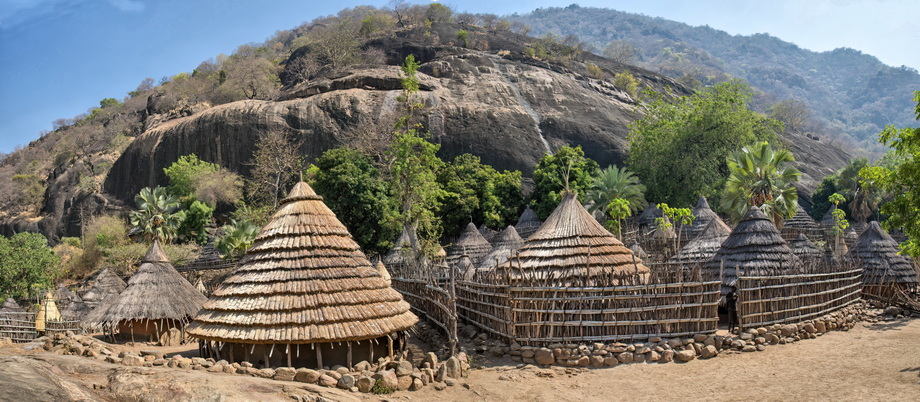
They reside in circular homes with cone-shaped roofs in homesteads organized by clan. They take pleasure in creating crafts and music as well. Even though there is a paramount chief, a hereditary post, the community decides decisions and the younger generation is free to challenge the more senior members. Didinga also lives in rustic camps.
An important aspect of Didinga society is the organization of "age grades" for boys. Every three to five years, boys who are around eight years old are placed together to form a new "age grade." These boys work and play together until they are married.
Didinga Religious beliefs:
The Didinga adhere to religious principles. The Didinga acknowledge the realm of spirits that interacts with the living, as do their neighbors and the existence of a supreme being. They revere and offer sacrifices to gods and spirits, and they give much weight to the veneration of departed ancestors.
Arrange with Ultimate Wild Safaris for a cultural tour of the Didinga tribe in South Sudan.
Email: This email address is being protected from spambots. You need JavaScript enabled to view it.
Mobile: +256 705 087 906 / 760 282 342